


- About the project
Reducing Food Waste and its Environmental Footprint through Sustainable Food Systems
The ECOFOODCYCLE project focuses on tackling food waste as a significant contributor to environmental pollution and climate change. It emphasises the systemic need for cross-border cooperation to implement effective prevention and reduction strategies. Food waste not only depletes natural resources but also generates methane emissions, a potent greenhouse gas.
ECOFOODCYCLE aims to promote sustainable practices across the Adriatic basin through pilot actions, awareness campaigns, and a stakeholder network. Its innovative approach integrates prevention and management, following the waste hierarchy outlined in EU directives.
Prevention First
Halting food surplus directly at production & kitchen sources.
Cross-Border Hub
Bridging IT-HR governance networks for shared resilience.
Social Redistribution
Connecting food banks, pantries, and civic aid groups dynamically.
TOTAL PROJECT VALUE
80% EU Co-Funded
€2,277,999.99
- PROJECT DURATION
- Priority 2: Green and resilient environment
30 Months
01/04/2024 – 30/09/2026
- PROJECT PARTNERS
- Lead: LIRA






- Partner: LIRA – Razvojna agencija Ličko-senjske županije
ECOFOODCYCLE ZERO WASTE INNOVATION LAB
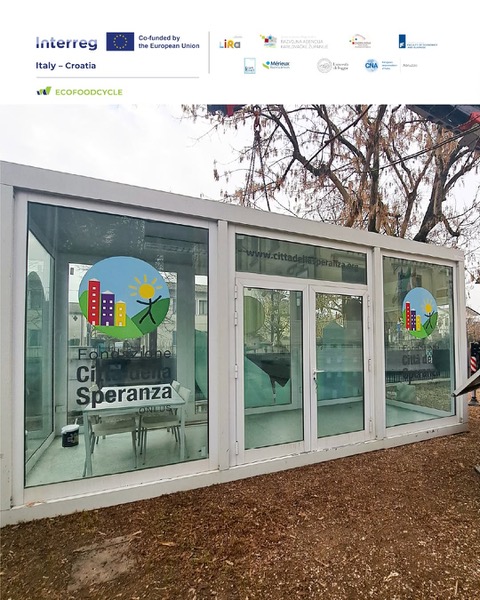
The ECOFOODCYCLE Zero Waste Innovation Lab is a facility built around one core premise: food waste does not have to end up in landfill, but can be processed into a resource, a new raw material, and a driver of local development.
The Lab is designed as a shared space where the scientific community, institutions, producers, and entrepreneurs can work together on solutions for reducing food waste and strengthening the circular economy. It gives users access to the equipment and practices this requires: freeze-drying technology that extends the shelf life of perishable fruit, methods for converting agricultural by-products into oils, pellets, and other value-added products, and training on building more sustainable, loss-resistant food systems.
Beyond its physical equipment, the Lab operates as an open platform for collaboration among these groups, intended to generate new ideas and solutions with long-term benefits for the local economy and the environment. Its role is therefore not limited to providing infrastructure but it also includes an ongoing programme of education and knowledge exchange among the stakeholders it brings together.
- Partner: JURRA – Razvojna agencija Karlovačke županije
REDUCING FOOD WASTE IN A SCHOOL KITCHEN
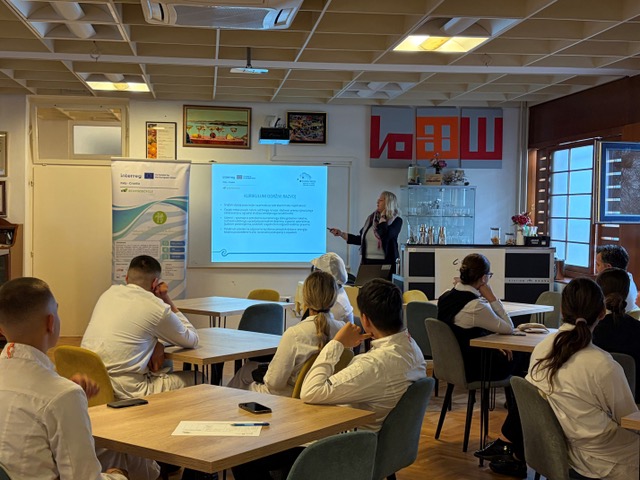
As a project partner in ECOFOODCYCLE, the Regional Development Agency of Karlovac County (RCK) ran a pilot activity in cooperation with the Karlovac School of Trade and Catering, focused on reducing food waste in a school kitchen environment. The pilot tracked the quantity of food waste generated during meal preparation, giving students and teachers direct exposure to sustainable bio-waste management and a more responsible approach to handling food in a real working kitchen.
The pilot responded to a structural feature of catering waste: food waste typically accounts for around 40% of total commercial catering waste, and roughly 77% of that share is liquid. Separating that liquid content at the point where the waste is generated, rather than after it has already been collected, was the basis for the equipment installed as part of this pilot.
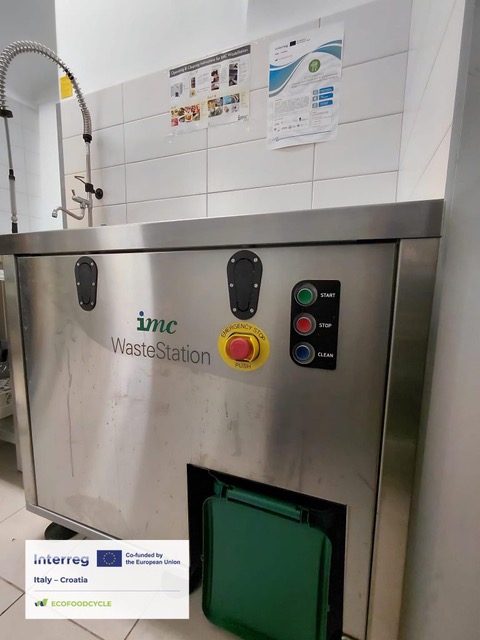
The new school kitchen, located in the RCK building, was equipped with a specialised bio-waste processing device that combined the functions of a grinder and a dehydrator. It ground food scraps and separated the excess liquid, which drained directly into the sewage system, while the resulting solid residue was collected separately for further processing. The reduction in volume and mass was substantial: around 10 kilograms of bio-waste was reduced to approximately 1 kilogram of solid material. The system was closed and self-cleaning, and emptied automatically, which simplified daily kitchen operations and reduced the need for on-site waste storage.
- Partner: ZADRA NOVA – Razvojna agencija Zadarske županije
TRACKING THE FOOD WASTE IN SCHOOL OF HOSPITALITY, TOURSIM AND CATERING, ZADAR
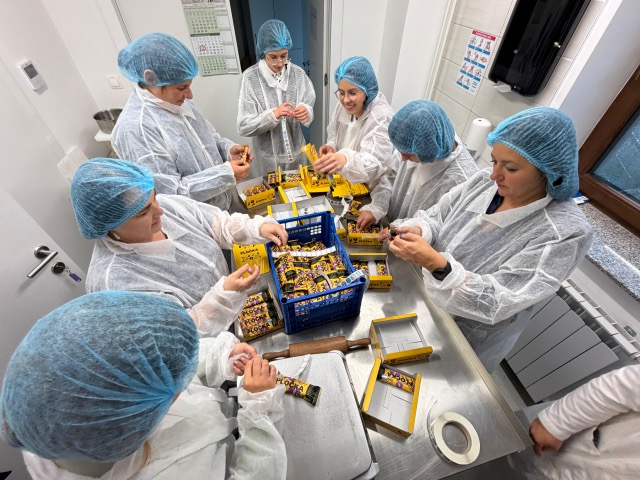
As a project partner in ECOFOODCYCLE, ZADRA NOVA – the Regional Development Agency of Zadar County – ran a pilot activity at the Zadar School of Hospitality, Tourism and Catering, focused on tracking the food waste generated during meal preparation and consumption and identifying ways to reduce it.
Using new kitchen equipment procured through the project, students carried out hands-on measurement and monitoring of the food waste produced in the school’s own kitchen. This gave them direct insight into the actual quantities involved and served as the basis for developing their own proposals and methods for reducing that waste.
The accompanying education covered the causes of food waste and its impact on the environment, the economy, and society, as well as the ways more responsible planning, proper use of ingredients, and more efficient resource management can help reduce it. As part of the activity, students also visited a fish farm and an almond farm, where they saw examples of good practice and sustainable approaches to food production first-hand.
Through this pilot, students strengthened the knowledge and competences they will carry into their future careers in the tourism and hospitality sector, where sustainable food management plays an increasingly important role.
- Partner: Ekonomski fakultet Sveučilišta u Rijeci
REDUCING FOOD WASTE AT VLADIMIR GORTAN ELEMENTARY SCHOOL
A pilot action titled “Reducing Food Waste at Vladimir Gortan Elementary School” was carried out in Rijeka from 19 November to 5 December 2025. The pilot was organised by the University of Rijeka’s Faculty of Economics and Business, in collaboration with the school community, teachers, canteen staff, and pupils, and aimed to bring real, measurable solutions into everyday school life — understanding how much food is wasted during school meals and encouraging children to adopt more responsible behaviour towards food and the environment.
The pilot combined monitoring, education, and practical action, turning the school into a testing ground for sustainable habits over the course of a few weeks. Its objectives were to measure food waste during school meals, raise awareness among pupils, encourage responsible food behaviour, develop simple and replicable solutions for schools, and enable students to analyse and present the results themselves.
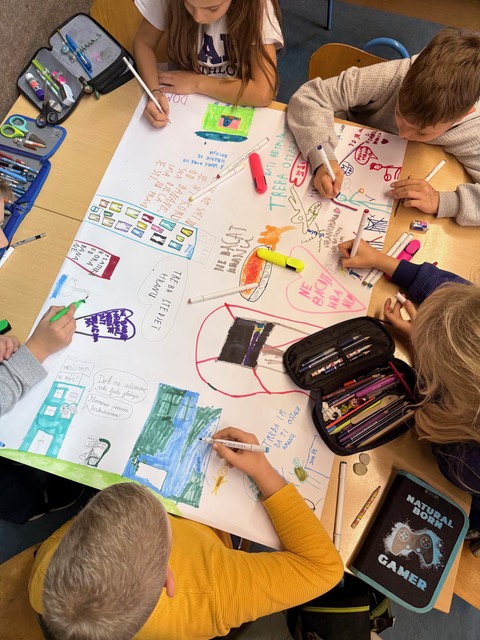
Pupils began by weighing their school lunch waste for a week. A three-member team from the Faculty of Economics and Business — Assoc. Prof. Ana Bobinac, Prof. Nenad Vretenar, and Nika Stipetić-Kalinić — then delivered a lecture and workshop introducing the pupils to the causes and consequences of food waste, after which the pupils created their own awareness posters on the issue.
Alongside the measurement and education, the pilot introduced several practical changes in the school canteen: behavioural nudges such as “Take fruit only if you will eat it all,” the reuse of uneaten fruit in juices and smoothies, and the installation of a professional food-waste grinder to divert waste from solid disposal.
Over the course of the pilot, lunch food waste fell from 27.27% to 19.71%, and average waste per pupil decreased by 38.4%. Uneaten fruit was reduced and partly redirected into beverages, food acceptance and sharing behaviours among pupils improved, and 22 pupils were actively engaged in the activities throughout. The results showed that combining education, small behavioural changes, and continuous monitoring can significantly reduce food waste within just a few weeks — and that the model can be readily replicated in other schools.
- Partner: ECAMRICERT / Mérieux NutriSciences
ECOFOOD WASTE TRUCK
EcamRicert — part of the Mérieux NutriSciences group — carried out a pilot action known as the “Ecofood Waste Truck” in Padova, at the Salboro “Luigi Luzzatti” primary school, in cooperation with the Municipality of Padova’s School Services Sector and School Canteen Office. Framed as a travelling laboratory for understanding the value of food the pilot turned the school’s own cafeteria into a space for learning about food waste, monitoring the waste generated through school meals, and building children’s awareness of responsible food use.
The pilot began with a period of pre-intervention monitoring, from 29 January to 6 February 2026, during which researchers documented pupils’ existing eating habits and waste patterns in the canteen. This was followed by educational games and workshops delivered across all five primary classes, helping children reflect on the significance of food and on anti-waste practices, alongside sessions built around the 2030 Agenda and hands-on anti-waste cooking labs.
As part of the programme, pupils took a field trip on 26 February to the Fattoria Ragazzi a Quattro Zampe, an educational farm in Due Carrare, where they learned about agricultural production and supply chains, circular-economy principles, seasonal sourcing, and the impact of food waste on water, soil, and energy use. A post-intervention assessment carried out in late February and early March then measured how pupils’ habits had changed since the start of the pilot.
The pilot closed in two stages. On 26 March 2026, an event at Padova’s municipal headquarters presented its results to an international audience, with pupils performing an English-language piece titled “Food Recycling”; the event was attended by Assessor for Community Programmes and Projects Margherita Cera. On 18 May 2026, the pilot concluded with the distribution of an anti-waste recipe book to pupils, bringing together recipes the children had developed during the workshops, in an event attended by Assessor for Educational and School Policies Cristina Piva.
- Partner: University of Foggia
SURPLUS FOOD BOX
The University of Foggia ran a pilot action in the Puglia region testing a “Surplus Food Box” model for reducing food waste at the retail level. The approach involved recovering surplus products nearing their expiration date and repackaging them into themed boxes made available to customers at designated points inside participating stores, combining product recovery with consumer awareness and behavioural change.
To implement the pilot, the retail chain “La Prima” supermarkets was selected as a single large-scale retail partner based in the Puglia region to co-design and run the pilot together with the university team, taking on the logistics of the boxes in-store, coordinating staff involvement, and working with the university on the accompanying awareness activities.
In practice, the pilot took the form of “smart boxes” — cardboard boxes with transparent windows — assembled each day from fresh products approaching their expiration date that would otherwise have gone unsold. Placed at designated points in-store, the boxes added a technological layer to the recovery model: customers could scan a box to activate an AI-based virtual assistant that identified its exact contents and suggested recipes for using them immediately.
- Partner: CNA Abruzzo
FOOD WASTE ON A FILM SET
CNA Abruzzo ran a pilot action testing food waste prevention on a film set, in collaboration with the Adriatic Film Festival. The film set was chosen specifically because it already operates under strict “green protocols” requiring cast and crew to follow environmentally responsible behaviour, making it a natural setting to test food waste reduction practices among a wide range of professionals — from writers and directors to actors, technicians, and costume designers.
The pilot was carried out in mid-March 2026 on the set of “Eco, il Suono della Montagna” (“Eco, the Sound of the Mountain”), filmed on the slopes of Mount Bertona in the Gran Sasso e Monti della Laga National Park. The film was directed by Maurizio Forcella and produced by Cristiano Di Felice for IFA Impresa di Produzione Cinematografica, in association with Visione Future, with support from the Cogecstre Cooperative and the Municipality of Montebello di Bertona.
On set, the pilot introduced a defined set of practices for measuring and reducing food waste: numbered food portions, weighing of food scraps, awareness-building activities for cast and crew, monitoring of food consumption throughout the production, and tracking of the results achieved. The aim was to give everyone involved in the production, regardless of their role, direct, hands-on exposure to sustainable food consumption practices they could carry into daily life.